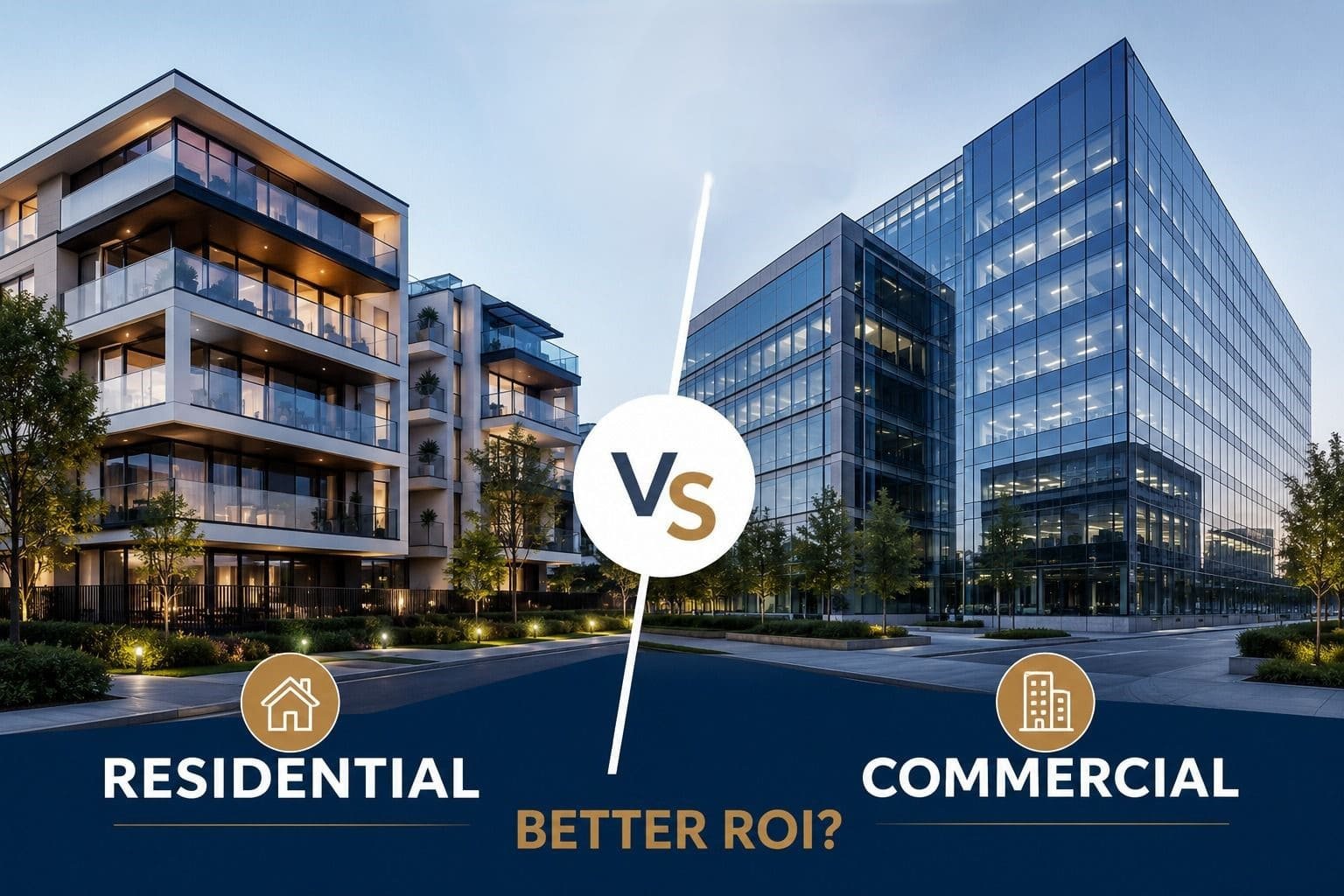
When it comes to building generational wealth, real estate remains the undisputed heavyweight champion of the investment world. But as we navigate the economic landscape of 2026, the age-old dilemma continues to puzzle both seasoned high-net-worth individuals (HNIs) and first-time buyers alike: Should you invest in residential or commercial property? To evaluate the **Residential vs Commercial Property ROI** landscape, we must analyze the ultimate metric that dictates the success of any real estate venture. However, a "good return" is no longer just about calculating monthly rent or waiting blindly for property prices to skyrocket. In today's mature market—especially within fast-evolving economic powerhouses like Delhi NCR and Gurgaon—the dynamics of capital appreciation, tenant profiles, and operational costs have completely transformed.
Choosing the wrong asset class can lock up your hard-earned capital in a low-yielding, illiquid investment. Conversely, a strategic choice aligned with your financial goals can create a predictable cash flow engine and an ever-growing safety net. This comprehensive 2026 investment guide breaks down the structural differences, risk profiles, and real-world returns of residential versus commercial properties to help you make an informed, highly profitable decision. If you want to review general topics first, you can read our Krishna Realty Insights Blog.
What is Residential Property?
A residential property is any real estate structure designed exclusively for living purposes. These properties cater to individual housing demands, ranging from single families to groups of working professionals looking for a place to call home. In the Indian real estate landscape, residential properties represent the most familiar and traditional form of real estate investment.
Examples of Residential Property:
- Studio Apartments & 1 BHKs: Popular among young working professionals and students in dense urban clusters.
- Luxury 3 BHK & 4 BHK Apartments: Gated communities featuring clubhouses, premium security, and dedicated lifestyle amenities, which are currently dominating the premium corridors of Gurgaon.
- Independent Floors: Multi-story residential layouts where each floor is owned individually, combining private living with community benefits.
- Villas & Penthouses: High-ticket, ultra-luxury assets targeted at HNIs and top-tier corporate executives.
What is Commercial Property?
A commercial property refers to any real estate asset used exclusively for business-related purposes or to provide a workspace rather than a living space. These properties are leased to corporate entities, retail business owners, or institutional tenants. Commercial real estate is typically looked at as an institutional asset class, but modern investment vehicles like fractional ownership and REITs (Real Estate Investment Trusts) have made it accessible to retail investors as well.
Examples of Commercial Property:
- Grade-A Office Spaces: High-end floors or entire buildings leased to MNCs, tech companies, and Global Capability Centres (GCCs).
- Retail Shops & High-Street Showrooms: Ground-floor commercial spaces located in highly foot-trafficked retail developments or malls.
- Shop-Cum-Office (SCO) Plots: A highly versatile hybrid model booming across Delhi NCR, allowing investors to build retail shops on the lower floors and offices on the upper floors.
- Warehouses & Industrial Logistics Hubs: Large-scale storage facilities located on the periphery of major expressways, driven heavily by quick-commerce and e-commerce expansion.
Understanding ROI in Real Estate
Before diving into a head-to-head comparison, it is critical to understand how returns are calculated in the property market. Real estate ROI is not a single number; it is a combination of regular inflows and long-term valuation growth.
The Real Estate ROI Formula
To calculate your total return, you must account for both the annual net income and the ultimate property valuation shift. The simplified baseline formula is:
Total ROI = [ (Annual Net Rental Income + Annual Capital Appreciation) / Total Investment Cost ] × 100
Where the Total Investment Cost includes the purchase price, stamp duty, registration charges, brokerage, and any immediate renovation costs.
Rental Yield
Rental yield measures the annual rental income generated by an asset as a percentage of its total cost.
Gross Rental Yield = (Gross Annual Rent / Property Purchase Price) × 100
Important Note: Net rental yield is always lower than gross yield because it subtracts recurring property taxes, monthly maintenance fees, insurance, and vacancy adjustments.
Capital Appreciation
Capital appreciation is the increase in the market value of your investment property over time. It is driven by macro-economic factors, infrastructural growth (like new metro lines or expressways), inflation, and localized demand-supply mismatches.
Cash Flow
Cash flow represents the actual money moving into and out of your bank account every month. A positive cash flow means your rental income easily covers your monthly loan EMIs, property taxes, and maintenance fees, leaving you with net profit.
Long-Term Growth vs. Short-Term Risks
Every real estate asset operates on an investment horizon. While residential properties offer softer, more resilient long-term growth with low entry barriers, commercial real estate provides powerful cash flow engines but carries a higher risk of prolonged vacancy during economic downturns.
Residential Property ROI: Deconstructed
Residential real estate remains the go-to avenue for millions of Indian investors due to its psychological comfort and ease of management. Let's explore the metrics that define residential property investment.
Residential Investment at a Glance
- Typical Rental Yields: 2.5% to 4.5%
- Long-Term Appreciation: Stable, compounding over time
- Entry Capital: Moderate to High
- Tenant Profile: Individuals and Families
Advantages of Residential Investments:
- High Liquidity and Large Buyer Pool: It is historically easier to find a buyer for a 3 BHK apartment than it is to offload a premium corporate office floor, as shelter is a universal human need.
- Easier Bank Financing: Financial institutions readily offer home loans covering up to 75% to 80% of the property value at relatively lower interest rates.
- Strong Emotional Value & Stability: During economic recessions, people might close businesses, but they rarely abandon their homes. Tenant stability remains highly predictable.
Disadvantages of Residential Investments:
- Low Rental Yields: The rental income from residential flats in India rarely crosses 3% to 4.5% of the capital value annually.
- High Maintenance and Tenant Turnover: Residential tenants change every 1 to 2 years on average, leading to painting, repair expenses, and frequent broker commissions.
Expected Returns
In 2026, the average residential property in a tier-1 micro-market yields around 2.8% to 4.5% in rental income, paired with an average annual capital appreciation of 8% to 15%, depending heavily on local infrastructure delivery.
Ideal Investor Profile
Residential real estate is perfect for risk-averse investors, first-time buyers, families looking for a safety net, and those looking to utilize home loan tax deductions while steadily building equity.
Commercial Property ROI: Deconstructed
If residential properties are built for stability, commercial real estate investment is designed for maximizing monthly cash flow.
Advantages of Commercial Investments:
- Industry-Leading Rental Yields: Commercial assets offer lucrative cash flow with yields routinely hovering between 7% and 10%, and touching up to 12% for premium SCO plots.
- Triple Net Leases (NNN): In Grade-A commercial contracts, the tenant is responsible for paying all operational costs, including property taxes, insurance, and routine maintenance costs.
- Unmatched Tenant Stability: Corporate entities and brands sign long-term lease agreements spanning 5 to 9 years, complete with built-in rental escalations of 15% every 3 years.
Triple Net Lease (NNN) Structure
Tenant Pays:
- Base Monthly Rent
- Common Area Maintenance (CAM) Charges
- Local Property Taxes
- Building Insurance Premium
Result: Predictable, Hands-Free Cash Flow
Disadvantages of Commercial Investments:
- High Capital Entry Barrier: Acquiring a meaningful standalone commercial space often requires a massive upfront investment, often starting at several crores.
- Severe Vacancy Risk: If a corporate tenant vacates an office building, finding another enterprise tenant can take 6 months to a year, resulting in extended zero-income periods.
Expected Returns
Investors looking at commercial property ROI can expect consistent rental returns of 7.5% to 11%, accompanied by an institutional capital growth rate of 6% to 12% per annum.
Ideal Investor Profile
Commercial property is tailormade for seasoned investors, corporate executives, HNIs, and NRIs who prioritize regular passive income streams over immediate emotional occupancy needs.
Residential vs Commercial Property Comparison
| Feature / Metric | Residential Property | Commercial Property |
|---|---|---|
| Average Rental Yield | 2.5% – 4.5% per annum | 7.0% – 10.5% per annum |
| Capital Appreciation | Higher in emerging infrastructure corridors | Highly tied to business performance & location |
| Initial Capital Required | Moderate (₹50 Lakhs to ₹3 Crores) | High (₹2 Crores to ₹15+ Crores) |
| Loan Availability | Easy; up to 80% financing; lower interest rates | Stricter criteria; commercial loan rates are higher |
| Lease Term / Horizon | Short-term (11 to 24 months) | Long-term (5 to 9+ year institutional leases) |
| Vacancy Risk | Low; easily rentable within 30-60 days | High; vacancies can stretch from 6 to 12 months |
| Maintenance Burden | Landlord covers major upkeep & repairs | Tenant handles fit-outs & operational maintenance |
| Liquidity Level | Relatively High; massive end-user resale pool | Moderate to Low; dependent on lease yields |
| Tax Benefits | Sections 24(b) and 80C available for loans | Deductions limited mostly to standard 30% upkeep |
| Ideal Investor | First-time buyers, defensive portfolios | High net-worth individuals, income-seekers |
| Monthly Cash Flow | Lower, often offset by loan repayments | Substantial, predictable, and robust |
Rental Yield Comparison: Residential vs Commercial
To put the numbers into a clear perspective, let's look at a realistic investment scenario. Imagine you have a capital pool of ₹2 Crores to deploy into the Delhi NCR real estate market.
Scenario A: The Residential Path
You purchase a premium 3 BHK apartment in an upscale gated community on the Golf Course Extension Road, Gurgaon for ₹2 Crores.
- Monthly Rent Realized: ₹55,000
- Annual Gross Rent: ₹6,60,000
- Gross Rental Yield:
(6,60,000 / 2,00,00,000) × 100 = 3.3%
After factoring in periodic societies maintenance gaps and brokerage fees, your true net rental yield hovers around 3.0%.
Scenario B: The Commercial Path
You deploy the exact same ₹2 Crores to purchase a Grade-A pre-leased retail shop or a premium corporate office space within an integrated commercial business park in Gurgaon.
- Monthly Rent Realized: ₹1,40,000
- Annual Gross Rent: ₹16,80,000
- Gross Rental Yield:
(16,80,000 / 2,00,00,000) × 100 = 8.4%
Because this is an institutional lease where the tenant bears the maintenance cost directly, your net rental yield remains exceptionally strong at 8.0%.
The Yield Verdict: For every rupee spent, commercial property delivers nearly 2.5 to 3 times more monthly rental income than residential options.
Capital Appreciation Comparison
While commercial property clearly dominates the rental income matrix, residential properties often make up for it via spectacular leaps in property appreciation, especially during structural growth phases.
Residential property values are deeply emotional and demographic. When an area becomes highly liveable—with elite schools, multi-specialty hospitals, and functional retail zones—thousands of families compete to buy homes there. This causes exponential residential price growth. For instance, micro-markets along the Dwarka Expressway have seen immense value scaling over the last few years due to pure end-user migration.
Commercial property appreciation, on the other hand, is directly mathematical and tied to the income the building generates. A commercial building’s value increases primarily when its rental income increases. If the market rents go up or a top-tier multi-national tenant signs a long-term lease extension, the underlying asset value scales upwards.
Deep-Dive Risk Analysis
Market Risk: The residential sector is less susceptible to sudden macro-economic slowdowns. Even during bad economic quarters, people need homes to live in. Commercial real estate, however, is heavily dependent on corporate health. If companies downsize or shift toward permanent hybrid work models, office space absorption rates drop rapidly, cooling the commercial market down.
Tenant Risk: Residential tenants can cause minor headaches regarding daily maintenance, but modern rental laws and comprehensive police verification systems offer excellent protection to landlords. Commercial tenant risks revolve around corporate bankruptcy or sudden relocations. If a commercial complex loses its anchor retail tenant, the overall footfall drops, affecting every single shop owner in that development.
Economic & Liquidity Risk: Residential real estate enjoys superior liquidity because your target exit audience includes millions of everyday end-users and families. Commercial exits require a sophisticated corporate investor or fund manager who will analyze your asset's capitalization rate (Cap Rate) and lease validity before signing on the dotted line.
Tax Benefits in India (2026 Regulations)
Residential Tax Incentives:
- Section 24(b): Homeowners can deduct up to ₹2 Lakhs per year against the interest paid on a home loan for a self-occupied property. For let-out properties, the entire interest component can be offset against rental income under specified terms.
- Section 80C: Offers a deduction of up to ₹1.5 Lakhs on the principal repayment component of a home loan (applicable under the old tax regime).
Commercial Tax Incentives:
- Standard 30% Deduction: Under Section 24(a), commercial property owners receive a flat 30% deduction on their gross annual rental income for maintenance and repair expenses, regardless of the actual amount spent.
- Depreciation Benefits: If the commercial property is registered under a business entity, owners can claim depreciation expenses against corporate revenues, substantially lowering net business income tax liabilities.
Micro-Market Spotlight: Commercial vs Residential in Gurgaon
Gurgaon has firmly established itself as the financial and technology epicenter of Northern India. If you are looking to deploy capital here in 2026, you must understand how different micro-markets behave.
- Golf Course Road & Cyber City: The undisputed crown jewel of NCR real estate. Cyber City remains the core corporate engine, making it the ultimate destination for institutional Grade-A office spaces. Meanwhile, Golf Course Road caters to ultra-luxury apartments and premium penthouses.
- Golf Course Extension Road & SPR Road: An absolute goldmine for premium residential spaces. In early 2026, Golf Course Extension Road recorded robust capital values, with premium apartments trading at over ₹22,000 per sq. ft.
- Dwarka Expressway & New Gurgaon: With the Dwarka Expressway completely operational and integrated with the multi-crore Global City initiative, sectors 84 to 113 are seeing rapid residential absorption, providing incredible long-term residential capital appreciation potential.
Current Real Estate Trends Shaping 2026
- The Rise of Institutional Tenants: Large Global Capability Centres (GCCs) are setting up long-term operational hubs in Gurgaon, taking up massive commercial office layouts.
- The Shift Toward Low-Density Luxury: Modern 2026 homebuyers prioritize low-density projects featuring more green open spaces, private common zones, and fewer flats per floor.
- The Shop-Cum-Office (SCO) Boom: SCO plots have completely revolutionized suburban commercial hubs along the Southern Peripheral Road (SPR) and Sohna Road, offering landowners total structural design flexibility.
- Fractional Ownership Democratization: Sebi-regulated fractional ownership vehicles allow investors to purchase shares of premium pre-leased commercial assets for as low as ₹25 Lakhs.
Expert Tips Before Investing
- Always Verify RERA Registration (HRERA).
- Analyze the Location's Infrastructure Timeline.
- Evaluate the Developer’s Execution History.
- Prioritize Pre-Leased Commercial Assets.
- Check the Lock-In Period Clauses in contracts.
- Assess the Loading Factor in Commercial Spaces.
- Opt for Low-Density Layouts in Residential.
- Understand the Local Circle Rates.
- Factor in Hidden Maintenance Overhead Costs.
- Target Emerging Transit-Oriented Developments (TODs).
- Check for Adequate Parking Allocation.
- Review the Tenant's Fit-Out Investment.
- Keep Your Investment Portfolio Diversified.
- Conduct a Formal Independent Legal Title Search.
- Partner with local Micro-Market Specialists like Krishna Realty.
Conclusion
Choosing between residential and commercial real estate depends on your personal financial goals, your investment budget, and your risk tolerance. Analyzing the **Residential vs Commercial Property ROI** helps you balance regular monthly cash flows against long-term capital growth assets. Residential properties offer a comfortable, low-volatility path with high resale liquidity, easy bank financing, and steady capital growth. On the flip side, commercial real estate stands out as a powerful cash flow engine, offering top-tier rental yields, long-term institutional leases, and corporate stability.
As the Delhi NCR and Gurgaon real estate markets mature through 2026, success comes down to choosing the right micro-market and doing thorough due diligence. Whether you are looking for a luxury apartment along the Dwarka Expressway or a pre-leased commercial office space near the Golf Course Extension Road, partnering with an experienced advisory firm is essential.
If you are ready to find high-ROI opportunities tailored to your investment goals, contact the expert team at Krishna Realty today. Let us help you navigate the market with data-driven insights and exclusive premier listings to secure your financial future. You can also explore all articles at the Insights Homepage.
About the Author
Amit Sharma is a Senior Real Estate Investment Strategist with over 15 years of hands-on experience tracking urban micro-markets across Delhi NCR and Gurgaon. Specializing in institutional property valuation, commercial leasing structures, and sustainable residential developments, his data-backed market insights help HNIs, corporate professionals, and NRI investors build high-yielding, resilient real estate portfolios.
Discussion (0)
Leave a Premium Comment
No comments yet. Be the first to share your thoughts!