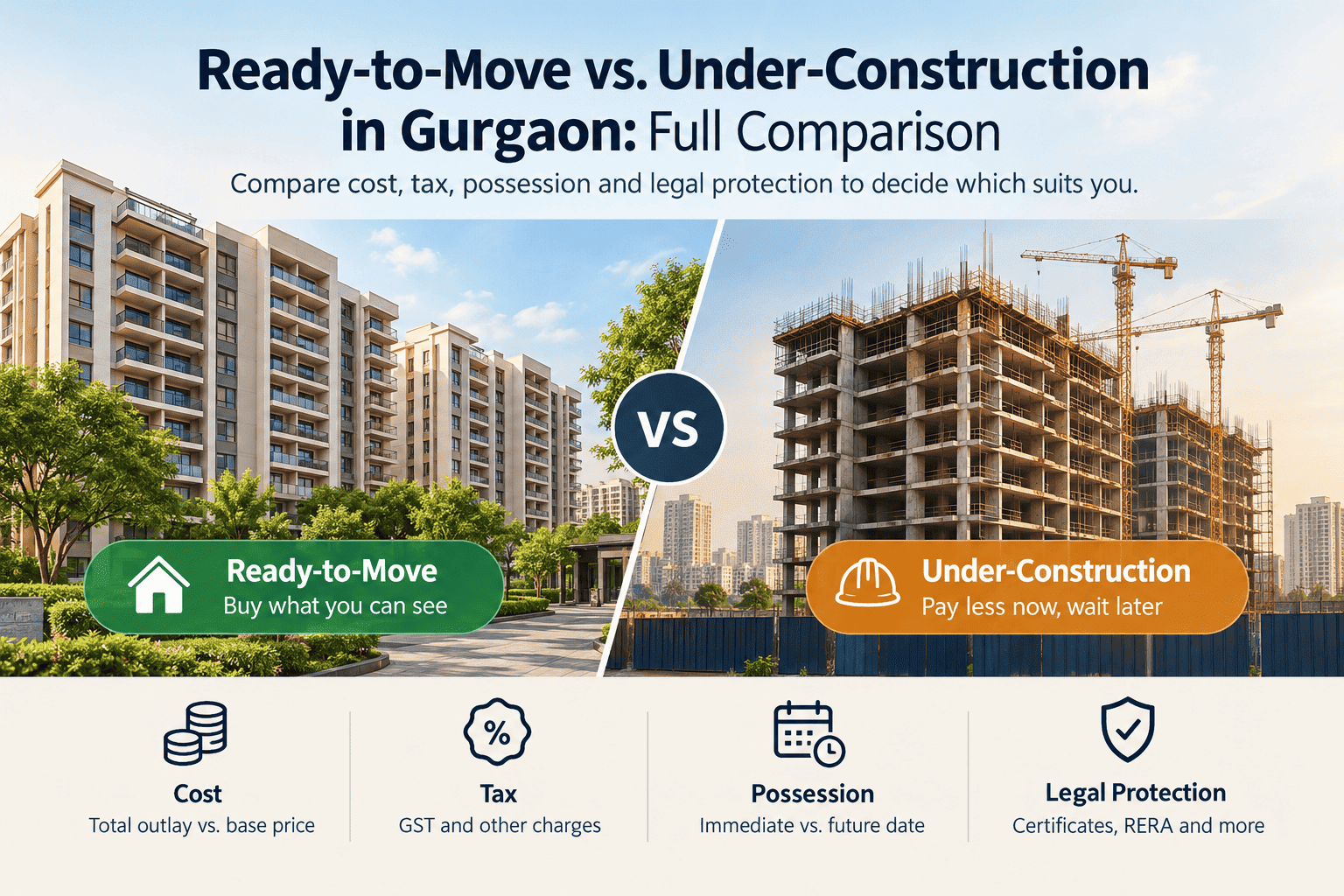
You have a budget, a shortlist of Gurgaon sectors, and one question that keeps coming back: pay more for a finished flat, or pay less now and wait?
The ready to move vs under construction in Gurgaon decision is really a choice between two kinds of risk, and the right answer depends on which one you can carry. Here is how cost, tax, possession and legal protection differ, and what to check before you transfer a rupee.
What “Ready-to-Move” and “Under-Construction” Mean on Paper
Brochures use “ready” loosely. The paperwork gives the real test.
For GST, what matters is whether the builder has received the completion certificate before the sale, as set out in the GST Council’s 34th meeting note published by PIB. For occupation, Haryana’s Town and Country Planning Department (DTCP) issues the occupation certificate (OC) for group housing colonies. The OC letters published on the Haryana RERA site list conditions such as fire clearance, electrical inspectorate approval and environmental clearance.
So call a flat ready only when the building is complete and those certificates are in hand. Anything earlier is under-construction, however close it looks, and you are buying against a completion date the developer declared to the regulator. Ask for the completion certificate and the occupation certificate by name; they are not the same document.
Possession-Ready Gurgaon Flats: What You Gain, What You Give Up
The case for possession-ready Gurgaon flats is simple: you buy what you can see.
- You can judge light, noise, the actual view, lift waiting times and how the society is maintained.
- A flat sold after the completion certificate carries no GST, according to the GST Council’s note.
- Move-in or rent can start straight away, so you avoid paying EMI and rent together.
The tradeoffs are very real. Broker and developer publications put the price premium over launch-stage units anywhere between 10% and 35%. Those figures are not specific to Gurgaon, so you are better off collecting comparable quotations than relying on a thumb rule. Ready stock also means fewer choices in floor and design. Older properties are likely to need renovation, while issues such as seepage and faulty wiring often do not show up in a single visit.
One point buyers tend to overlook is Section 3(2)(b) of the RERA Act, which exempted projects that had already received their completion certificate before the Act came into force on 1 May 2017 from registration. For older societies there will be no Haryana RERA project page to consult, so your OC, sale deed and society dues matter more.
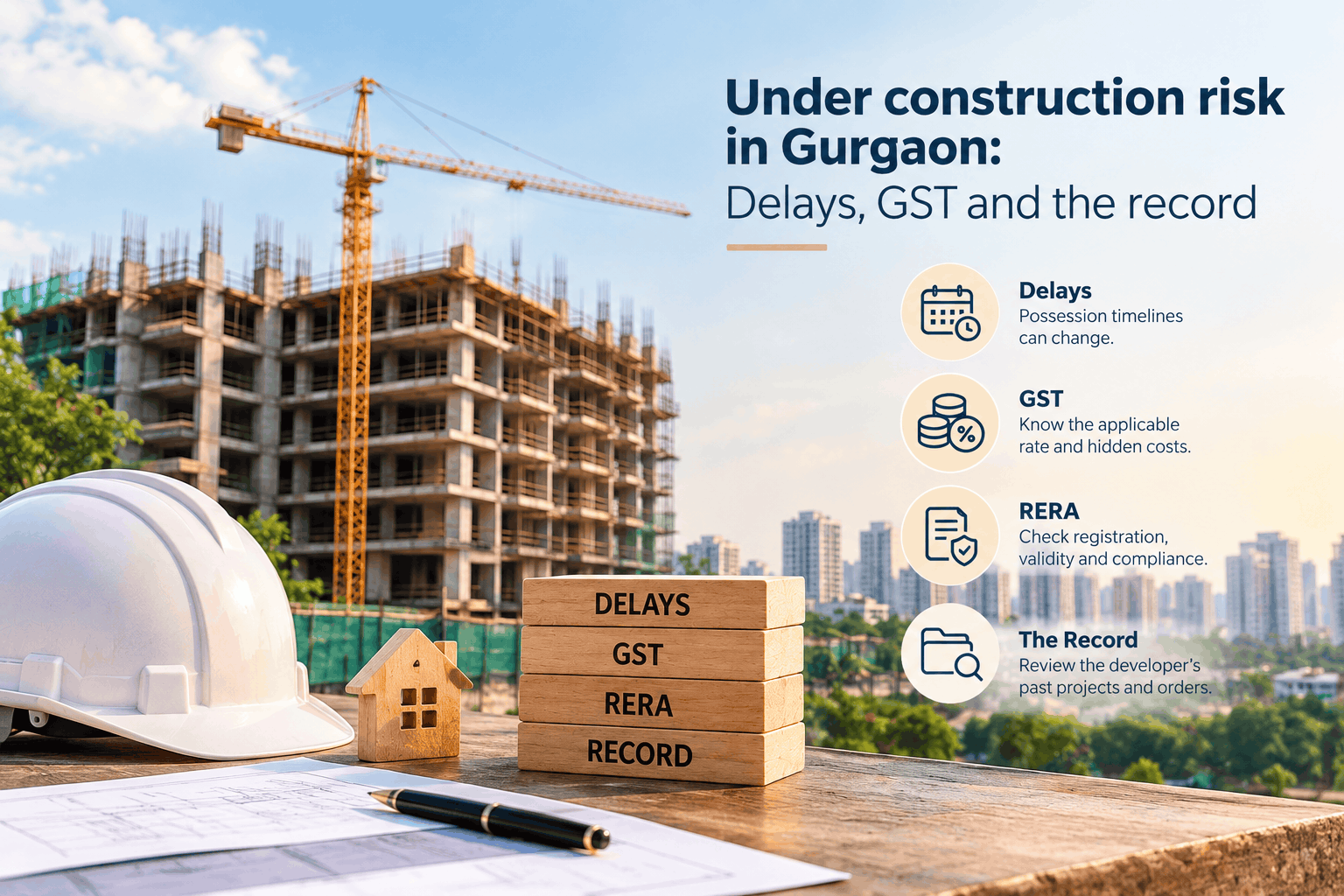
Under-Construction Risk in Gurgaon: Delays, GST and the Record
Under-construction flats usually come with a lower entry price, staged payments and more choice of unit. Against that, GST applies at 5%, or 1% for affordable housing within the Council’s ₹45 lakh value cap, both without input tax credit, per the same PIB note. Confirm the current rate with your chartered accountant before booking.
Delay is the main under-construction risk Gurgaon buyers should price in. Section 18(1) of the RERA Act entitles a buyer who stays in the project to interest for every month of delay until handover. In Haryana the rate comes from Rule 15 of the state rules: SBI’s highest MCLR plus 2%, as applied in orders of Haryana RERA and its Appellate Tribunal. Awards in the orders reviewed worked out to roughly 9% to 11% a year. In an order passed on 29 September and reported by The Tribune on 14 October 2026, HRERA Gurugram directed 10.80% interest to 26 buyers of an affordable housing project in Sector 108 after the handover deadline passed.
Two cautions. Interest compensates you; it does not give back the years or the home. And an “offer of possession” is not the same as ready: in a reported order, Haryana RERA treated a possession offer made before the occupation certificate as invalid and still awarded delay interest (LiveLaw). Several HRERA complaint orders also involve projects that were unregistered or whose registration had expired, which is why the checks below matter.
Ready-to-Move vs Under-Construction at a Glance
| Factor | Ready-to-move | Under-construction |
|---|---|---|
| What you buy | The actual flat | A plan, brochure and sample flat |
| GST | Nil if sold after completion certificate | 5% (1% affordable), no input credit |
| Entry price | Higher; the premium varies by project | Lower base price, GST on top |
| Payment | Mostly paid at purchase | Staged against construction or builder schedule |
| Possession | Immediate once OC and papers are verified | Per the registered date; delay possible |
| Main risk | Hidden defects, old paperwork, no RERA page for pre-2017 projects | Delay, plan changes, developer stress |
| If it goes wrong | Civil or consumer routes; HRERA if registered | HRERA complaint under Section 18 |
Compare Total Cost, Not Sticker Price
A lower base price can still lose once everything is added. Build the same sum for each flat: base price, GST if applicable, stamp duty and registration, plus charges such as EDC/IDC and club membership. Then add the cost of waiting: rent you keep paying and interest on any loan already running. Ask your chartered accountant how home-loan interest is treated before possession under the current income tax rules, since that differs from the period after handover.
Run this per project. In some projects the under-construction discount survives the GST and the wait; in others, especially near possession, it has already narrowed.
How to Check a Project Before You Pay
If It Is Under Construction
- Look up the project on the Haryana RERA website. Ensure the registration number is valid and shows the right completion date.
- Compare that with the possession date in your builder buyer agreement. Also compare the delay interest rate with Rule 15.
- Check the developer’s previous Gurgaon deliveries and any HRERA orders against them.
- Ask for the licence, sanctioned plan and environment clearance details.
If It Is Possession-Ready
- Obtain the occupation certificate and find out who issued it. Also obtain the completion certificate.
- Check for seepage, wiring, fittings, lifts, firefighting equipment and parking. For larger apartments, get an expert to conduct a snagging inspection.
- Get the no-dues certificate and find out about any maintenance dues.
- Have a lawyer verify the title and conveyance. If the project is an older one, also check whether it was ever registered under RERA.
Which Option Suits Which Buyer?
So, is it better to buy ready to move or under construction in Gurgaon? It depends on your situation:
- You must move within about a year (school admissions, a job change, ending a lease): ready-to-move flats in Gurgaon remove the delivery risk.
- You want rent from day one: a ready flat starts earning once tenanted; an under-construction one cannot.
- You have a 3-5 year horizon and a reserve for delay: under-construction flats in Gurgaon from a developer with a verifiable record can make sense, if you track the RERA updates.
- Budget is tight: compare total outlay, then stress-test it. Could you carry EMI plus rent for two extra years?
These timelines are rules of thumb, not official figures.
Conclusion
Neither option wins in every case. Ready-to-move gives certainty, but at a cost. Under-construction gives a more affordable way in, but with the risk of delay, which Section 18 and HRERA can compensate for but not undo. When comparing ready to move vs under construction in Gurgaon, it all boils down to time and patience.
Next step: tell us your budget, timeline and preferred sectors. We will shortlist ready and under-construction options side by side and walk you through the documents. Browse apartments in Gurgaon or speak to our team. If you are still choosing a micro-market, our comparison of Golf Course Extension Road and New Gurgaon is a good companion read.
Frequently Asked Questions (FAQs)
Not Sure Whether to Buy Ready or Wait?
Tell us your budget, timeline and preferred sectors, and we will shortlist ready and under-construction options side by side.
Disclaimer: This article is for general informational purposes only and is not legal, tax or investment advice. Tax rates, regulations and court or authority orders change. Verify current information on official portals and consult a qualified advocate or chartered accountant before you pay any booking amount.















No comments yet. Be the first to share your thoughts!